Rhodesia in Film
26 June 2026
The first feature film that should be mentioned with regard to Rhodesia is Shangani Patrol (1970). The last is Blood Diamond (2006).
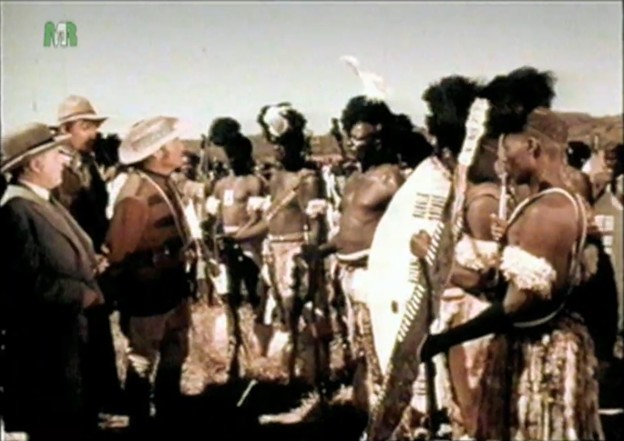
Shangani Patrol is in many ways the most important. It is of course not a Rhodesian production. Rhodesia was too small to have its own movie industry. It barely had a television station. And even that is described as embarrassing by those who remember watching it. Shangani Patrol is a South African production, but it was wholly filmed in Rhodesia and features many Rhodesians as extras. The most notable extras in the movie are the Ndbele who play their ancestors of just three or four generations earlier, the warriors of King Lobengula’s impis who fought the first white settlers in what came to be known as the First Matabele War.
Until 1893, the settlers had farmed and mined Mashonaland on concessions granted by Lobengula and were essentially under his protection. The price paid for the concessions had been in gold and rifles. The Matabeles were a northern offshoot of the Zulu whose social structure was similarly organized along martial lines. The whites feared them and avoided entering Matabeleland proper. But as white settlement grew and took a more permanent form, the settlers became more disturbed by the ongoing Matabele raids on the Shona. The Matabele did not harm the whites, whom they regarded as their wards. But the whites did not like seeing the brutalities committed on the Shona so close to white farms, homes, and businesses, especially as the white communities now contained larger numbers of women and children. Also, the expanding farms and mines were increasingly dependent on Shona labor and the Matabele raids made Shona workers scarce.
Things came to a head sometime in 1893. In the movie, Dr. Leander Starr Jameson, one of the officers of the British South Africa Company, is seen heading off a Matabele raiding party by threatening them with a Maxim gun. The Matabele regarded this as a declaration of war. It was a war they lost.
|
|
As for the Shangani Patrol incident depicted in the movie and in numerous other Rhodesian works of art, both its purpose and the circumstances of its final encirclement remain unclear. Two things are certain: A party of 34 men led by Major Allan Wilson were killed by Matabele warriors on December 4, 1893. And, this incident had absolutely no effect on the outcome of the war. By that time the Matabele had already quit their capital of Bulawayo and were retreating northwards. After massacring the Shangani Patrol, they continued on their northward retreat.
Making the details of the patrol even more murky, the party originally consisted of 37 men. Three of them, including the American Frederick Russell Burnham, managed to escape unscathed.
When visiting Rhodesia in the 1960s to research his History of Rhodesia, Robert Blake noted the ubiquity of popular artistic depictions of the Shangani Patrol in public places. He puts forth the theory that the reason Rhodesians invested such importance in this event was that the loss of life on their side proved they had made sacrifices to gain their country. The war had otherwise proceeded relatively easily for them. This sense of needing to sacrifice to prove they belonged and were not just colonial tourists was also likely a large part of their motivation for fighting the extended “Bush War” three quarters of a century later.
Another possible source of appeal in the Shangani legend is the idea that the whites earned the respect of the Africans, similar to the events at the Battle of Rorke's Drift as depicted in the 1964 British movie Zulu. In Shangani Partol, the Matabele induna who finds the patrol’s remains calls them: “men, whose fathers were men before them”. He also orders that their bodies not be mutilated as would have been done to the bodies of Shona.
Among the many places named after Allan Wilson is Allan Wilson High School in Harare. While most white names in Zimbabwe have been changed, Allan Wilson High School retains its name. The school’s sports cheer is still “Umkhulubafana,” isiNdebele for “Men of men”.
After the war, Cecil John Rhodes made a rare visit to the country that was to bear his name. The division of land and cattle he came to an agreement with the Matabele over became the basis of what would later evolve into the TTL system. The Shona were largely ignored. Robert Blake quotes the Matabele telling Rhodes “The Shona are our dogs.”
Three years later, the Shona would revolt in what came to be known as the Second Matabele War. The Matabele joined in as well. The Shona are 80% of the population of Zimbabwe and they call the Second Matabele War the “First Chimurenga,” a Shona word meaning struggle. They call the Rhodesian Bush War of the 1970s the “Second Chimurenga.”
Ian Smith and other Rhodesians liked to point out that if not for the Matabele Wars, the Shona would still be enslaved by the Matabele. They also liked to point out that the Matabele had crossed the Limpopo a mere half a century before the whites and so were hardly any more indigenous.
Rhodes indicated in his will that he wished the 34 soldiers killed in the Shangani Patrol buried alongside him at his chosen final resting place in the Matopos Mountains. The final scene in the movie is of Burnham standing at the site observing the graves.
From a purely artistic standpoint, the most impressive part of Shangani Patrol is the score by Michael Hankinson.
Game for Vultures (1979) was the last movie filmed in Rhodesia. The country ceased to exist not long after its release. Its two main characters are a white Rhodesian (Richard Harris) and a black nationalist (Richard Roundtree) who are both portrayed sympathetically and are allowed to get some points across. Roundtree is a bit too American to make a convincing African, but the performances are solid. Both portray peace and freedom loving men who feel compelled to commit immoral acts in the causes they believe in.
If Harris comes off as a bit too British, there is a plot-motivated reason for it. He plays a particularly suave Rhodesian who travels the world under an assumed identity setting up deals to help his country evade sanctions. He gets no sympathy but must rely on money and connivance to get what he wants. Also memorable is the British journalist who is so convulsed with hatred for Rhodesia that he forgets to look before crossing the street.
Roundtree’s character kidnaps children and is involved in the murder of missionaries. He is clearly not indifferent to the implications of these acts, but he will not be dissuaded either. There is an implication that when the war is won, men like him who risked their lives and their conscience will be pushed aside by bigger men who risked nothing and have no conscience.
A year earlier, Harris had starred in Wild Geese with Richard Burton and Roger Moore. It is based on the novel of the same name by Rhodesian novelist Daniel Carney. Wild Geese depicts mercenaries from around the English-speaking world recruited by devious British agents to risk their lives in an impossible operation to smuggle an African president back to the country he has been deposed from.
Another novel of Carney’s, The Square Circle, was made into a movie called Wild Geese II, although it does not star any of the same actors.
Whispering Death a.k.a. Albino a.k.a Night of the Askari (1976) is based on the novel The Whispering Death, also by Daniel Carney. It was filmed entirely in Rhodesia and depicts the Rhodesian Bush War in a particularly brutal light. It is a West German production and stars German actor Horst Frank as the monster-movie like albino African who gives the movie its alternative title. The movie is somewhat exploitive in the prurient interest and has the psychology more of a horror movie than a war movie, but it does depict many scenes of rural Rhodesia at the time.
The depiction of the rural police station is particularly memorable and the policemen are recognizably Rhodesian. British actor Trevor Howard portrays an old generation Rhodesian at home in the ranch house he has no intention of ever moving away from. South African actor Sam Williams portrays an African fighting on the Rhodesian side. And this must be the only movie to depict a pungwe, the consciousness-raising revolutionary sessions conducted by ZANU that involved the torture and mutilation of insufficiently revolutionary Africans.
Daniel Carney is perhaps the closest Rhodesia came to having a home-grown intellectual who did not completely detest his own country. And he was but the author of what might be called pulp novels.
More typical is Doris Lessing, a more serious author who is infinitely more famous and who also won the Nobel prize. Many of her fans are not even aware of her Rhodesian origins. Only two of her dozens of books are about Rhodesia: the non-fiction Going Home and her first novel The Grass Is Singing, first published in 1950.
The movie The Grass Is Singing (1981) has erased all mention of Rhodesia. Moviegoers probably assumed it is set in South Africa. The novel is about the descent into tragedy and madness of an idealist dreamer of a white farmer in southern Africa, his estranged city wife, and her affair with their precocious black employee. According to Duncan Clark, the novel is one of the only pre-1980 works by white authors allowed to be taught in Zimbabwean schools.
The movie was directed by Michael Raeburn, another Rhodesia-hating Rhodesian intellectual. His first film was a 1969 short titled Rhodesia Countdown in which he foretold the end of Rhodesia. In 2003, he followed this up with Zimbabwe Countdown, his take on the downfall of Zimbabwe under Mugabe.
Wake in Fright (1971) is an Australian movie that makes no mention of Rhodesia. Yet the physical and psychological landscape of the Australian outback as depicted in Wake in Fright are eerily similar to what might have been depicted if such a movie had been made at the time in Rhodesia. Or maybe not. It’s hard to say since no such movie was ever made in Rhodesia. So Wake in Fright might be as close we get.
The scenes of the educated schoolteacher bored out of his mind and descending into alcoholism teaching school children in a one-room schoolhouse are eerily similar to Doris Lessing’s recountings in Going Home of what was told to her by a friend who had become an education inspector:
There’s a teacher. He’s been swotting and struggling for that ruddy Standard IV certificate for years, and then he got it, and he was in a kraal school at last, a big man with all his six years’ schooling behind him and all’s hunkydory. So then I went out to inspect. I found him there in that pitiful, bloody little school, next door to a whacking great church, needless to say, and he had his sixty kids sitting on the mud floor in neat little rows all chanting the ABC in Shona, and there he was drunk as a lord and staggering around like a sick chicken. I said to him, “Aren’t you ashamed, Joshua? Aren’t you ashamed, my man, with all these poor little kids dependent on you for their education?” He wept bitter tears and said, “Yes, sir,” he would never do it again. “You’d better not,” I said to him, and I went off in my fine government lorry to the next school 100 miles off. Then I heard it was time I went and had another look, so I packed myself into my lorry and off I went, 300 miles, and there was Joshua, lying on the ground under the tree outside the school, and there were his class, still sitting in neat rows in the hut on the floor, repeating after themselves, “Mary had a little lamb,” maintaining perfect discipline in their efforts to get educated even without a teacher. So I lost my rag, I can tell you. I got him to his feet and shook him sober and said he’d have one more chance. Six months later, out I went, there he was, drunker, if possible, so I gave him the sack. I gave him the sack there and then. The poor bastard wept and wailed and he said all his father’s savings for fifteen years had gone into his getting Standard IV; but what could I do? I sacked him.
And the fictional town of Bundanyabba as depicted in the movie seems like the same kind of southern hemisphere English-speaking colonial town as small regional centers in Rhodesia like Sinoia, Gwelo, Selukwe, Enkeldoorn, Que Que, Fort Victoria, Umtali, or even — no offense intended — Bulawayo or Salisbury. The dusty street, the trading post and municipal building. The gruff farmers and miners who eat prodigious amounts of meat and drink prodigious amounts of alcohol, who hunt and fight as soon as breathe, but cry sentimental tears at the mention of war dead. And their insane levels of pride in their colonial enterprise. When the smug schoolteacher waiting for the train to Sydney expresses his disgust at the place, an old rancher who overhears him insists on inviting him to his home to experience what a wonderful place Bundanyabba really is. He harbors no grudge against the teacher. He truly believes that anyone who fails to love “the ‘Yabba” just must not have seen enough of it yet.
To a large extent, the makers of Wake in Fright share the prejudices of the main character. This is true because the educated classes who write books and produce culture will almost uniformly look down on ranchers, farmers, miners, and settlers and attribute to them every pathology. This is certainly true of the educated classes in Britain. Note how even counter-culture heroes Monty Python make fun of Australians in such classic skits as the famous “Bruces sketch” and “Australian Table Wines”. The very idea that Australians could engage in the production of philosophy or fine wine was comical to the British ruling class.
And this same prejudice and snobbery extends to educated Australians as well, as personified in the character of the schoolteacher. The developing plot in the movie demolishes any claim the teacher might have had to any superiority over the locals. And there is a grudging nod to their old-fashion ideas of morality when the teacher, now humiliated and chastened, returns to the general store the next day and finds his suitcase exactly where he left it, untouched.
And yet the movie itself is not free of the same prejudice that depicts the locals as brutal and depraved. They cannot be free of this prejudice since by definition, only educated people make movies and so the fact that the locals do not make movies or fine art just proves how contemptible they are. And maybe the educated classes have a valid point. But maybe you need uncultured, rowdy pioneers to lay the track, the production of food and the basis of industry before you can have movies, museums, and philharmonic orchestras.
The 19th century novel Heart of Darkness was not just about the “horror” of Europeans in Africa, but about recognition that the Romans must have experienced something similar two thousand years earlier when they first conquered Britain. In Wake in Fright, the character of Doc Tydon has accepted this realization while the teacher has not. The difference is that Mr. Kurtz was encountering African savages while Doc and the teacher are having a similar reaction upon encountering white Australians.
The earliest appearance of Rhodesia in a major motion picture is probably Mozambique (1964). The movie is of course about the country of the title and not about Rhodesia. The only direct connection to Rhodesia is the final car chase, which was filmed at Victoria Falls probably for no other reason than the makers of the film thought it would be cool to film a car chase at Vic Falls. And it kind of is. Perhaps the Rhodesian government also offered them a tax break to film there.
The movie Mozambique was filmed a decade before the end of Portuguese rule in that country but it is very much about the end of colonial rule in Africa. The movie’s central plot concerns drug smuggling and is somewhat forgettable. The memorable moments, besides the final car chase, are the depiction of small-time down-and-outers in the surprisingly cosmopolitan capital Lourenço Marques (now renamed Maputo) and depiction of the end of Arab rule in Zanzibar to the north.
The Portuguese port Beira was a popular tourist destination for Rhodesians until 1974. Steven Abramowitz recounts stealthily listening to Lourenço Marques Radio in his room after he was supposed to be asleep because “if you wanted to hear the good music, you had to listen to LM Radio.” Lourenço Marques must have been a sort of a skid-row version of what Alexandria, Egypt must once have been in the age before Nasser. And Mozambique is sort of a skid-row version of James Bond.
A year before the film’s making, Zanzibar had been abandoned by the British with the intention that it become another independent African country. Instead, it was absorbed by the already independent Tanganyika. That country then changed its name to Tanzania, a compendium of Tanganyika and Zanzibar. Zanzibar had for centuries been dominated by Arabs who exported African slaves through it to the Middle East.
One of the key villains in Mozambique is an Arab Sheik from Zanzibar. Yes, his wealth comes from smuggling drugs and probably worse. But you can’t hate him all that much. He’s an aristocrat of the old school, a cultured gentleman of sorts. And he will soon have to flee Africa and he knows it. As he says in one scene: “Even in these revolutionary times, we can still extend hospitality.” And the African governments who will replace him will not be better.
Blood Diamond is likely the last movie that will ever be made that mentions Rhodesia. It is a big budget Hollywood action movie starring the famous actor Leonardo DiCaprio as a character who repeatedly states that he is Rhodesian. The jury is still out on how successful DiCaprio is at embodying the mannerisms and speech patterns of Rhodesians, but it is obvious and significant that he invested considerable efforts in the attempt.
The word “propaganda” should not be seen in a wholly negative light. It simply means art for a cause. It can often be very bad. But just because something is propaganda does not mean it can’t be art, can’t be entertaining or even beautiful, or that the cause it is promoting should be dismissed merely because the art is mobilized. Blood Diamond may not be a great movie or even very effective propaganda, but it should not be utterly dismissed simply because it is propaganda.
Blood Diamond is propaganda for the diamond industry, which by the beginning of the 21st century had come under heavy criticism of trafficking diamonds from unethical sources. The movie fully admits the severity of the issue and even the title of the movie acknowledges it. The ultimate aim of the movie is to convince the public that the diamond industry has taken the criticism to heart and taken steps mend its ways.
The choice to make the main character, Danny Archer, a Rhodesian serves the propaganda aims of the movie. The character through which the audience sees Africa could not have been an employee of the diamond industry. And a western investigative journalist or a black African victim would have been too easily regarded as a cliché. In fact the movie does feature both a western investigative journalist and a black African victim who both serve the purposes you would expect. But Danny, the white African outsider who has both lost his homeland and been denied his identity, pushes the viewer to pay more attention. You have to learn who Danny Archer really is and maybe in the process you will begin to care more about the bigger issues.
The timeframe necessitates that Danny not be old enough to have fought in the Rhodesian Bush War. That would have made him too old to be engaging in the kind of swashbuckling seen here. It also might have associated him too much with the Rhodesian military cause which is often lumped together with the hated South Africa Apartheid regime. Instead, Danny’s parents were killed in the war he was too young to serve in, making him more sympathetic. Lost and denied the opportunity to serve his new country of Zimbabwe because he is white, he gains his military experience fighting as a mercenary in other African wars under the command of a South African general. In fact, many Rhodesians in the last two decades of the 20th century fought as mercenaries, in particular in South Africa and Angola.
When we meet Danny, he is tough, cynical, and alienated. He has never been outside of Africa in his life, but no country in Africa is his home. He is as willing to fight for the diamond industry as against it if the price is right. He has no greater purpose and no future. When he first tells the journalist (Jennifer Connelly) that he is Rhodesian. She snaps back that “It’s called Zimbabwe now.” The rejection he feels must be common to many Rhodesians. It had not been his intention to criticize Zimbabwe, that’s just not who he is. And who he is is invisible to the contemporary world.
The Africa we see in Blood Diamond is similar to Africa as depicted in Lord of War which was made one year earlier. Lord of War is also propaganda, this time directed against the international arms trade. The two causes these movies advance are not unimportant and the fact that they are propaganda does not make them bad movies, although they are somewhat artificial in places. The two causes are also not mutually exclusive. In Blood Diamond, the focus is the violence committed by Africans on other Africans for the possession of diamonds. In Lord of War, the focus is on the weapons the Africans use to murder each other in large numbers. In neither movie are white people shown killing Africans. But the implication in both is that it is the western profit motive in selling weapons or sourcing diamonds that fuels violence on this scale.
And in both movies the hero is a white outsider who is able to profit by his not being intimidated by Africa, but who is eventually saddened and destroyed by it. The main character of Lord of War is Yuri Orlov (Nicolas Cage), a Ukrainian whose family emigrated to America after the breakup of the Soviet Union and assumed a Jewish identity. He is not at home in America or the Ukraine or anywhere else, but discovers he has a knack for moving weapons stolen by his relatives from Soviet arms depots. He is ultimately depicted as another victim of the apathy of the world towards the endless killing in Africa.
Unlike Yuri, Danny Archer is given a chance at redemption when he embraces the cause of uniting Solomon Vandy (Djimon Hounsou) with his wife and children who have been kidnapped by diamond traffickers. As in Lord of War, most everyone is in some way a victim of western apathy. The only outright villain is the South African general who has a noticeably Afrikaner name. It’s hard to find anyone who will stand up for Afrikaners. Rhodesians have often born grudges against them, too, both before and after Rhodesian independence.
In the end, Blood Diamond leads us to believe that Danny’s sacrifice has not been in vain, as the remaining characters speak at a conference that will somehow institute safeguards to guarantee that only conflict-free diamonds will be sourced. But it is hard to believe that much has really changed. As long as African countries remain despairing and misgoverned, what could a sticker on a jewelry box really signify? As Danny Archer himself might say: “T.I.A.” (this is Africa).